Understanding the Difference Between ERP and PIM

Introduction
Managing product information efficiently is crucial to success in eCommerce. That’s why companies most often use an ERP (Enterprise Resource Planning) and/or PIM (Product Information Management) system to manage products. But what exactly are ERP and PIM used for? And how do they fit into the eCommerce landscape? Do you need both systems or is one enough?
In this article we cover their main differences and show how they complement each other. And above all: where ERP ends and where the work begins that no one else will do for you, from content and SEO to prices set per channel.
Why This Topic Matters
Bad product data is not a cosmetic problem, it costs money. An out-of-date price on a busy weekend means selling below cost. A missing parameter or image means the customer does not buy. Inconsistent data between your eShop and a marketplace means returns and cancellations.
The more channels and products you have, the more expensive it is to keep data in order by hand. ERP and PIM solve two different parts of this problem. ERP looks after how the company runs internally, PIM looks after what the customer sees. If the two do not talk to each other, you pay for it in both efficiency and revenue.
What is ERP in eCommerce?
ERP is software that helps businesses manage their internal operations. It supports key functions such as finance, human resources, supply chain management, procurement, and manufacturing. For eCommerce companies, ERP is important for overseeing internal processes and ensuring smooth operations behind the scenes. It helps businesses track inventory, manage orders, control logistics, and handle accounting, among other tasks.
However, it is important to note that ERP is not a sales or marketing system. It focuses on internal business operations, managing data that supports main processes but doesn’t necessarily address the customer-facing product information required for marketing and sales purposes.
What Data Does ERP Manage in eCommerce?
ERP primarily manages master data, which includes:
- Product SKUs (Stock Keeping Units)
- Product dimensions and weights
- Manufacturer Details
- Customs classifications and compliance information
- Basic categorization and logistical data
- Base prices and stock levels
ERP systems like SAP, Oracle, and Microsoft Dynamics are well-known for handling these tasks. Czech tools that are often used are Helios, Pohoda or Abra.
ERP Limitations
One of the main disadvantages of ERP systems is managing product information for customers, such as images, videos, or descriptions. This data is essential because a customer who is unable to track down the necessary information for a product is unlikely to buy the product. However, ERP systems often do not have the space or flexibility to handle more detailed or specialized content, such as 3D models, datasheets for more complex products, or additional product codes.
As a result, some companies store key data in inappropriate places, such as in the ‘notes’ field. ERP systems are often not equipped for multi-channel sales, where content needs to be tailored to different customer groups or regions.
Sales strategies may be specific to different target groups – some products may only be offered on selected sites or to certain customer segments with different prices, promotions, labels, and other data. Each site may require a different product ranking, topping of items of interest, different categorization, or specific SEO values. However conventional ERP systems either have nowhere to store this data or are unable to manage it independently for each site.
What is PIM in eCommerce?
PIM is a system that acts as a single source of truth for all product-related data. It centralizes and organizes product information such as descriptions, images, videos, technical specifications, and multimedia content like 3D models or technical sheets. PIM ensures that customer-facing data is consistent, accurate, and engaging, helping businesses maintain a high-quality product experience across multiple eCommerce channels.
What Data Does PIM Manage in eCommerce?
PIM handles a wide variety of product information, from basic details like SKUs, sizes, and stock levels to more detailed content like marketing descriptions, SEO-friendly texts, and region-specific information. It allows businesses to easily manage this data across different sales channels, such as eCommerce sites, online marketplaces, and B2B platforms, ensuring each channel has the right and up-to-date information.
For example, WisePorter is built so that the business team runs product management itself, not IT. From one place, a product manager sets which data is kept for each product and uses rules to define the calculations and checks that a person would otherwise do by hand. A new product then goes on sale across channels in minutes instead of hours or days. And because the system watches data quality, an error never reaches the web until someone fixes it.
What makes WisePorter different
Most PIM systems can centralize product data and send it to channels, and they usually treat price as just another field on the product. WisePorter goes further and handles the whole pricing process. For us, pricing is not a single static number on a product, but a whole chain of calculations, from real purchase costs to the final selling price.
The whole system runs on clear business rules, much like formulas in Excel, that an ordinary user can manage without programming. Whenever any input changes, for example a supplier’s purchase price or the euro exchange rate, WisePorter automatically recalculates prices across the entire portfolio and protects your profitability with a built-in margin guardrail.
PIM’s Strengths in Multichannel Management
PIM’s greatest strength lies in its ability to centralize product data and customize it for different markets, regions, or customer segments. It simplifies the process of scaling by making it easy to update and distribute product information across various sales channels, reducing errors and saving time. This ensures a smooth multichannel strategy, allowing businesses to expand their reach, optimize customer engagement, and adapt quickly to new market demands.
ERP vs. PIM: What Are the Key Differences?
ERP and PIM: Purpose and Functionality
The main difference between ERP and PIM lies in their core functionalities:
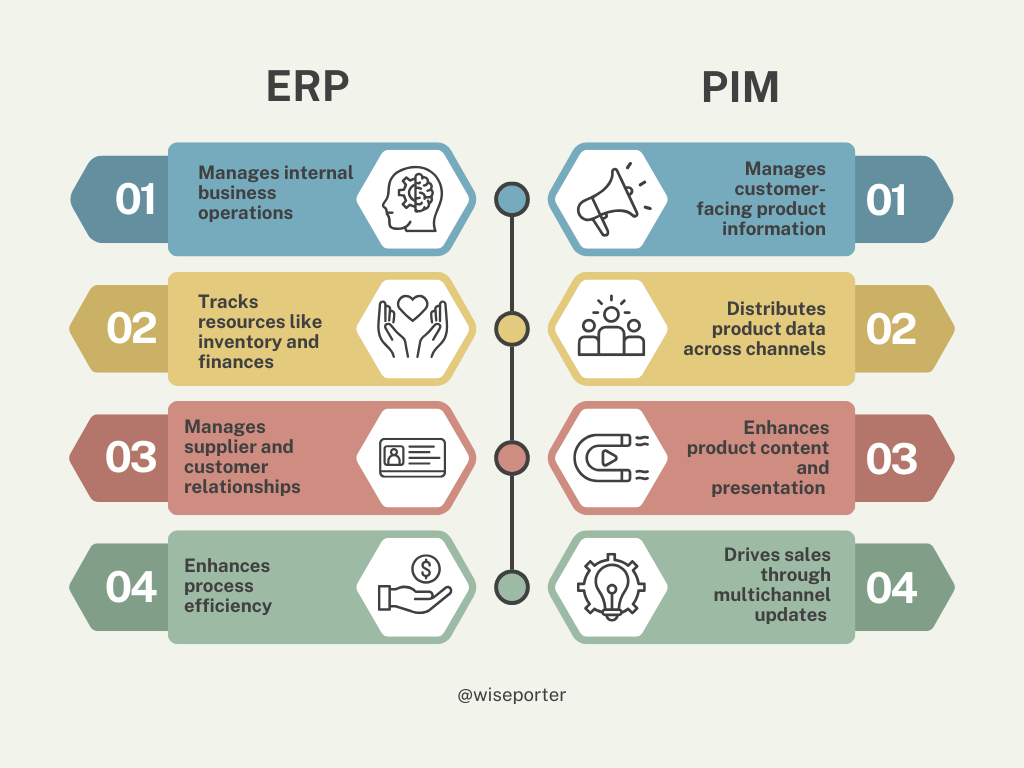
- ERP systems focus on internal operations, such as inventory management, accounting, and supply chain coordination.
- PIM systems focus on managing and distributing product information to output channels (sales and marketing).
To put it simply, ERP supports the back-end processes necessary for running a business, whereas PIM is all about enhancing sales, marketing, and customer engagement.
ERP and PIM: Product Information Scope
ERP manages basic product attributes like SKUs, dimensions, and stock levels. These are essential for managing the logistical side of the business.
PIM focuses on rich product data, such as marketing copy, product images, videos, and SEO-optimized descriptions that can vary depending on the target audience or sales channel.
In short: the base price sits in ERP, and the selling price, which varies by channel, segment, or promotion, sits in PIM. On top of that, WisePorter works with price from cost all the way to sale: it takes the supplier’s invoice price, adds overhead costs, applies margin, and calculates the final selling price.
ERP and PIM: Scalability and Multichannel Sales
While ERP systems are essential for managing back-end data, they often lack the flexibility needed for scaling. For example, if you sell products in multiple countries, an ERP won’t have the features necessary to handle the specific needs of individual markets.
This is where a PIM system excels. PIM can manage product data across various sales channels. Whether you’re selling on your own eShop, online marketplaces like Amazon or Heureka.cz, or on B2B platforms, PIM allows you to easily manage all information from one place. You can easily modify descriptions, prices, and images, add attachments such as PDFs, and 3D models, or set SEO for each channel individually. PIM ensures that every platform has the correct and up-to-date information. Moreover, when you need to change details (such as adding a new image or updating a description), you don’t have to do it in each channel or system separately – you just update it in the PIM, and the change is automatically reflected everywhere. Additionally, you can tailor your sales strategy to different target audiences – some products can be available only on select websites or at different prices with unique promotional offers.
PIM also allows you to set various labels, and product rankings, highlight featured items, or configure specific categorizations and SEO values for each channel. These kinds of information typically cannot be stored in a standard ERP system. And if they can, it’s not done independently for each site.
The key difference between ERP and PIM is that ERP focuses on internal business operations, while PIM manages customer-facing product data, making it essential for enhancing sales and marketing across multiple channels.
Do You Need Both ERP and PIM for Your eCommerce Business?
When is ERP Enough?
For small eCommerce businesses with limited product catalogs and simple sales channels, an ERP system might be sufficient. If your primary focus is on managing inventory, tracking orders, and processing payments, ERP can meet these needs without the added complexity of a PIM system.
When Should You Consider PIM?
As your business grows, managing product information becomes increasingly complex. If you’re expanding into new markets, managing thousands of products, or selling across multiple channels, a PIM system becomes essential.
Signs that you need a PIM system:
- You’re manually updating product data across several platforms.
- Product information is inconsistent across channels.
- You’re experiencing delays in launching new products or campaigns due to inefficient product management.
Conclusion
While both ERP and PIM systems are critical tools for eCommerce businesses, they serve different but complementary purposes. ERP focuses on managing internal processes like inventory and accounting, whereas PIM specializes in handling the customer-facing product data that drives sales. As your business grows and your product catalog expands, integrating both systems can significantly improve efficiency, reduce manual errors, and ensure a seamless customer experience across all channels.
And if you manage not only product data but also prices and margins, it makes sense to look for a solution that handles both in one place.
FAQ
WisePorter can offer you flexible and simple solutions to your difficulties and ensure customer satisfaction. Shift your business from operations to strategy and try our FREE DEMO version now.
The article was created in collaboration with Martin Šteffan.
Did you like the article?
Check out other popular topics and follow us on LinkedIn.